


Microsoft Copilot Consulting: Using Copilot for Companies Successfully and in Line with Data Protection
Many companies want to put Microsoft Copilot to profitable use quickly. But the AI tool carries data-protection risks and, without the right approach, quickly loses acceptance among employees. With our Microsoft Copilot consulting, AI expertise and our change approach, you avoid pitfalls, make your employees' work considerably easier and secure the success of the Copilot rollout for the long term.
Our Clients






























Microsoft Copilot Consulting – Our Solutions for You
The Microsoft Copilot rollout needs clear rules, sensible use cases and convinced employees. That's why our holistic M365 Copilot consulting puts data protection, value and acceptance equally in focus.

1. GDPR-compliant Copilot use
1. GDPR-compliant Copilot use
In the first step we work with you to develop a tailored policy that bindingly defines key decisions on the use of AI, especially on Copilot data protection. Together with your AI leads, our experts examine the opportunities and risks of Copilot for your company to ensure broad acceptance and practical suitability. A central topic: Copilot can access company data and evaluate it for its results – based on existing user permissions. To ensure data-protection compliance, we therefore place particular focus on limiting the volume of processed data. The result is a sound, individual policy that enables responsible, secure Copilot data protection in your company.

2. Focus on your most important use cases
2. Focus on your most important use cases
Together with selected stakeholders we test concrete Microsoft Copilot use cases in the company – from Outlook and Teams through Word and Excel to Copilot agents in the Microsoft 365 apps. As orientation we draw on use cases with which comparable organizations have already had positive experiences. In doing so we focus on your value and time savings per use case. We also always weigh Copilot data protection and the efficiency of Copilot in everyday company work carefully against each other.

3. The right dose of change management
3. The right dose of change management
As the No. 1 experts for change, we know that some employees approach AI in a professional context with a healthy dose of scepticism. Others, in turn, underestimate Microsoft Copilot data protection and the risks it can create for your company. Our change management meets your employees where they are and puts them at the center of the change. With easy-to-understand Copilot use cases we create positive experiences of success, dismantle reservations and raise awareness of potential pitfalls.

4. Tutorials and training tailored to your needs
4. Tutorials and training tailored to your needs
Our tutorials are the basis for rolling out promising Microsoft Copilot use cases across your entire organization. Using concrete examples, this makes clear to all employees how to comply with Copilot data protection and integrate the tool into their workflow in a value-adding way. Alongside tutorials, our training ensures that your employees understand the policy, accept it and apply it in everyday work. We explain the background of the policy, show the effects of individual behavior and set out how Copilot can be used in line with the GDPR. Beyond Microsoft Copilot data protection, we also show how generative AI and Copilot support value creation in the company and where the limits of their use lie.
“We carefully weigh Copilot data protection and everyday efficiency against each other to ensure safe value.”
Michael Kempf, Partner at CPC

Your Benefits

Focused and successful
We identify the best Microsoft Copilot use cases for your company. This delivers noticeable time savings and real value in everyday work.

Reliable and secure
Based on the identified risks, you receive a sound policy that secures Microsoft Copilot data protection and creates clear rules for AI use in the company.

Employee-oriented
Our change management conveys to your employees the need to integrate Microsoft Copilot into their daily work. This strengthens acceptance and turns scepticism into active participation.

Goal-oriented
We show your employees how to use Copilot for their daily tasks: in a targeted, efficient and data-protection-compliant way – based on their roles and existing permissions.

Individual
Our tutorials and training fit your company and your challenges. They make Copilot understandable, practical and ensure broad adoption in your organization.
Discuss your initiative with us
“With easy-to-understand use cases we create experiences of success, dismantle reservations and raise awareness of data-protection pitfalls.”
Oliver Kleinknecht, Partner at CPC

About Us


consultants deployed worldwide for you.
projects delivered successfully for our clients.
focus on change management.
of the DAX40 companies trust us.


1. We understand business
To advise organizations on change projects, you need an entrepreneurial eye and a feel for business. For us, change management is never an end in itself, but always economically justified.


2. We work globally
If we aren't already on site, we go wherever our clients need us. In doing so, we set up concepts internationally from the outset.


3. We think change digitally
We have a strong affinity for digital topics. Since our founding we have supported many change projects in the IT environment. We are curious about what moves companies forward technically and has a positive effect on their business.


4. We strengthen everyone on the team
A company in which employees enjoy their work – that's what we work hard on every day. This is exactly the attitude with which we do consulting. Because for us, people are at the center of every transformation.


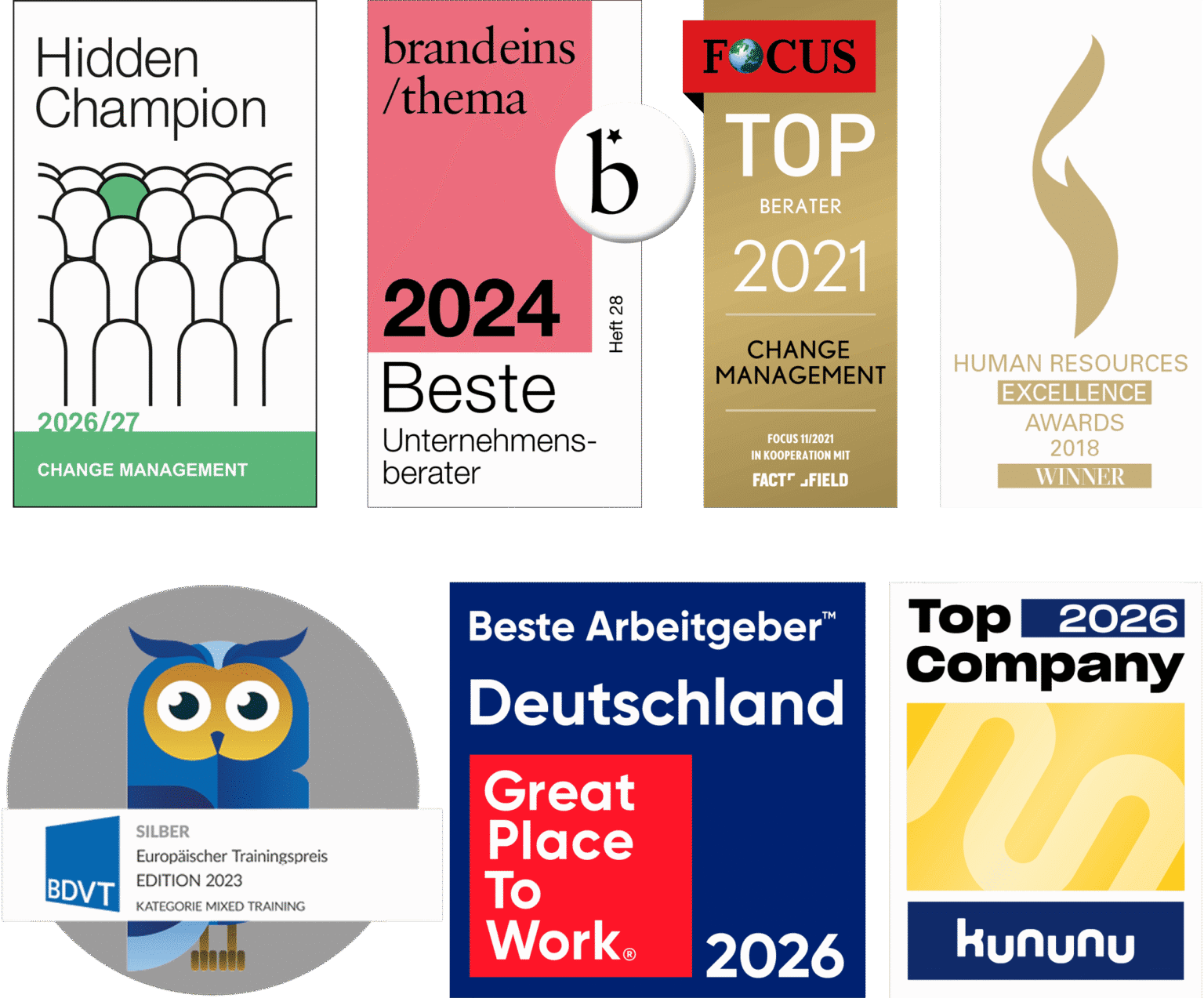
We're grateful for these awards
- CPC is a five-time No. 1 Hidden Champion for change management
- Year after year, brandeins/thema names us Germany's best management consultancy for change management
- We have been a Focus Top Consultant for many years
- Winner of the HR Excellence Award and the European Training Prize together with Deutsche Telekom and Lufthansa Technik
- We are No. 1 Great Place to Work in the 51–100 employees category and a Kununu Top Company.


Let's discuss
your project with us!
The first step is easy — and don't worry: we won't send you dull newsletters or annoying promotional emails. Instead, we focus on what matters: your change goals and how we can move your business forward.

Step 1
Call back or email.
Within 24 hours we get in touch with you, capture your requirements and arrange an appointment with one of our experts.
Step 2
Free initial consultation.
In a video call you explain your project and discuss possible solution scenarios together with our expert.
Step 3
You decide how to proceed.
Proposal, pitch or project kickoff? You set the next steps.
Questions and Answers
Microsoft Copilot consulting typically includes analyzing the IT and data landscape, defining Copilot use cases, reviewing data-protection and compliance requirements, and technical implementation. In addition, training, change-management measures and the development of a governance structure are offered to ensure safe and sustainable use of Copilot in the company.
Change management is a central component of every Microsoft Copilot consulting engagement. Introducing AI changes ways of working and requires acceptance among employees. Through targeted communication measures, training and pilot projects, the use of Copilot is encouraged. This ensures that the technology is not only implemented but also actively and effectively used.
Microsoft Copilot consulting usually begins with an analysis phase in which existing systems, data structures and processes are assessed. This is followed by the design of use cases and a rollout strategy. Copilot features are then implemented, employees are trained and change measures are carried out. Finally, success is measured against defined KPIs for continuous optimization.
Microsoft Copilot consulting is particularly worthwhile for companies that use Microsoft 365 and want to boost their productivity through AI. It is suitable for mid-sized companies as well as for large organizations with complex processes. Companies with a high documentation workload, many communication processes or the desire for automation and efficiency gains benefit especially.
Microsoft Copilot consulting enables a structured and secure introduction of AI technologies. Companies benefit from clearly defined use cases, higher efficiency in work processes and better use of existing data. In addition, risks relating to data protection and compliance are minimized, while acceptance among employees is increased through targeted training and change-management measures.