Change Management Models: The Most Important Frameworks for Successful Transformations
Whether digitalisation, reorganisation or cultural change – change processes are part of everyday life in many companies today. From our experience in change management projects we know: success rarely depends on strategy alone. What matters far more is how change is planned, communicated and anchored in the company. Proven change management models offer valuable orientation here. How you translate that orientation into concrete project work is what we show you with our CPC Change method.
Our Clients





























What are change management models?
Change management models are proven frameworks that make change in organisations plannable. They restructure complex change into comprehensible steps and phases. This gives leaders a clear roadmap for their initiative.
Every model sets its own priorities. Some emphasise the emotional journey of employees, others the structural leadership of change. Still others focus on the interplay of all elements of an organisation.
All change management models pursue the same goal: they aim to increase the success of change. Studies show that around 70 % of all change management projects fall short of their goals. The reason usually lies in people, structures or communication being involved too little. A model provides the common thread for getting better at exactly that.
Why do companies need structured change management models?
Change with a system saves friction, time and energy. A change management model creates clarity about sequence, responsibilities and milestones. This gives leaders confidence in steering the process.
Employees benefit at the same time: they experience change as a comprehensible process. That strengthens trust and encourages active participation. Change succeeds when employees are actively involved.
“Complex change needs a clear framework. Change management models create structure and help keep the essentials in view.”
Michael Babilon-Teubenbacher, Partner at CPC

Change management methods overview – the 5 most important models
The following list shows the 5 most widespread change management models. Each model sets a different focus and suits different situations in the company.
- Lewin's 3-phase model: unfreezing, moving, refreezing as the basic structure of every change.
- Kotter's 8-step model: eight clear leadership steps for large transformations.
- Kotter's Accelerate: dual organisation of hierarchy and agile network.
- ADKAR model: five stages of individual change for every employee.
- Krüger's 5-phase model: German practical model for complex change with an iceberg approach.
These five models provide valuable orientation. For day-to-day project work we use our own, practice-proven CPC Change method. It carries the strengths of the models over into a concrete approach.
Lewin's 3-phase model: unfreezing, moving, refreezing
Lewin's 3-phase model is considered the forefather of all change management models. The social psychologist Kurt Lewin developed it in 1947 on the basis of his field theory of human behaviour. To this day it provides the conceptual foundation of many later frameworks.
Lewin's core idea was simple and effective: every stable state arises from a balance between driving and restraining forces. Change means deliberately shifting that balance, establishing a new state and finally stabilising it.

Unfreezing


Moving

Refreezing
In today's practice, however, the model quickly reaches its limits. Change now often follows in close succession, and genuine refreezing is barely achievable. The value of the model therefore lies above all in its clear logic of thought.
“Models make change understandable and structurable. They create a shared language for leaders, project teams and employees.”
Jördis Andersson, Partner at CPC
Kotter's 8-step model: leading change step by step
John P. Kotter, professor at Harvard Business School, published his influential 8-step model in 1996. It is aimed above all at leaders steering large transformations. Kotter emphasises that change needs clear leadership.
The model was based on Kotter's analysis of more than 100 transformation projects in companies worldwide. In doing so he identified eight typical mistakes that slow change down. His model is the direct answer to them: every step addresses one of these points.
Kotter's 8-step model is particularly suited to comprehensive transformations with a clear leadership logic. The first three steps prepare the ground, the middle steps drive the change, the final steps secure the success. That is why many DAX companies value this model for large projects such as strategy implementations or digitalisation initiatives.


Kotter's Accelerate: the dual organisation
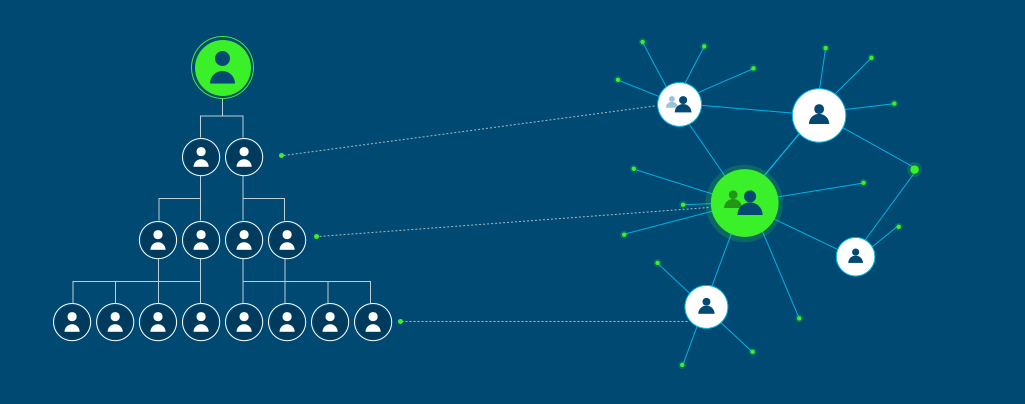
Kotter developed his thinking further in 2014 and published Accelerate. Behind it stands the idea of the dual organisation, the so-called dual operating system. It combines two organisational forms and two leadership styles.
- The management driven hierarchy: through fixed structures and procedures it ensures high reliability and operational excellence.
- The decentralised accelerator network: it seizes opportunities, initiates change and develops the organisation continuously.
Both structures are closely interwoven, and employees are part of both worlds. This allows companies to seize major entrepreneurial opportunities. A dual organisation rests on five principles and eight accelerators:

Bottom-up
Strategically important initiatives do not emerge only in top management. Every employee can contribute initiatives and drive them forward responsibly.

Voluntariness
Employees decide for themselves whether to take part in initiatives.

Purpose
Communicating the purpose of the change works rationally and emotionally at the same time.

Leadership
In the accelerator network responsibility is spread across many shoulders instead of individual positions.

Networking
The formal hierarchy and the accelerator network work in close interlock.
The eight accelerators largely coincide with the 8-step model. Accelerate does, however, take into account that transformations keep growing larger. Many companies also run several change initiatives in parallel.
In practice the concept remains demanding. Kotter himself concedes that no company has yet managed to implement it fully. The approach therefore mainly provides valuable impulses for agile structures.
The ADKAR model:
people as the key to change
The ADKAR model comes from Jeff Hiatt, the founder of Prosci. It places not the organisation but the individual person at the centre. Because change only succeeds if every person supports it. This perspective sets ADKAR fundamentally apart from structural frameworks such as Lewin or Kotter.
ADKAR is an acronym for five stages that every person goes through in the transition. Anyone who passes through all five stages actively supports the change and accelerates the overall process.
The ADKAR model complements structural frameworks such as Kotter or Lewin ideally. Kotter describes what the organisation as a whole has to do. ADKAR answers what every individual needs for it. Connecting both levels covers the macro as well as the micro level of change. That is why we deliberately pick up the spirit of ADKAR in many projects.
Krüger's five-phase model: a German practical model with depth
Wilfried Krüger, professor at the University of Gießen, developed a five-phase model specifically for complex change processes in companies. It covers initialisation, conception, mobilisation, implementation and perpetuation. In the German-speaking world it has proven particularly effective and is applied in consulting projects with mid-sized companies and large corporations alike.
Krüger complements his phase model with the famous iceberg model of change. It distinguishes between visible factual topics such as strategy, structure and processes and invisible topics such as values, power interests and relationships. Teams therefore gain a great deal when they look beyond the tip of the iceberg at the forces below the surface.
This makes the Krüger model particularly valuable for the German-speaking corporate environment. It systematically integrates the political and cultural dimensions of change. International models such as Kotter's 8-step model address these in less differentiated ways.
The CPC Change method: practice-proven instead of theoretical
CPC is number one for change management in Germany. Inspired by the classic change models, we developed our own method over many years: CPC Change – practice-tested, free of theoretical ballast, value-adding and always enriched with the latest project insights.
The method consists of two core phases and an optional third phase:
- Change Initiation: we analyse your change needs and plan all measures. For this we use four highly effective modules: change analysis, change story, change network map and change architecture.
- Change Implementation: we put everything necessary into practice. For this we use modules such as change management office, change communication, change leadership, change agent network, user communities as well as training & enabling.
- Change Institutionalisation (optional): we anchor the know-how deliberately in your organisation. Future change then succeeds under your own steam.
With our proven CPC Change you make full use of the potential of your change project. You achieve sustainable change in the company because your employees understand the new direction, support it and actively shape it.


“With CPC Change we translate proven insights from various change management models into a pragmatic method for concrete project work.”
Michael Kempf, Partner at CPC

Change management models compared: which model fits when?
The following comparison table shows the most important change management models side by side:
What classic change management models leave open
As useful as change management models are, they have clear limits. Anyone who treats them as rigid recipes gives away impact. A critical look at the main weaknesses is therefore part of dealing professionally with these frameworks.
Choosing the right model: what we learned in over 2,500 projects
In the 2000s we took the classic route. First we analysed which model suited the company. Then we set up the project along that model. In practice, however, it turned out that every company faces its own individual challenges and therefore needs a tailored solution.
All models also have clear weaknesses as soon as things get concrete. They describe phases but provide hardly any concrete measures for day-to-day project work. They stay abstract where teams need clear steps and roles. They also account for neither the pace nor the parallelism of today's transformations, which makes them hard to apply directly in practice.
From this experience we developed our own answer: the CPC Change method. It is practice-proven, concrete and has been tested and sharpened in more than 2,500 projects. You therefore do not start with a pure question of models but directly with your own goal.
The classic models retain their value in this, because they continue to provide valuable food for thought. On your request we are happy to emphasise the spirit of individual models in your project. Particularly often we pick up the ADKAR model, for example, because it consistently puts your employees at the centre.
“A change management model is no cure-all. It creates a reliable framework that we fill with life to fit the change at hand.”
Diana Herr, Senior Manager at CPC

Change management models in practice: how CPC supports your company
CPC specialises in change management and has sharpened its own consulting approach in more than 2,500 projects. We use the established change management models as a toolbox and complement them with our own methods and the new change formula. Because every company deserves tailored support that responds to its specific context.
Our change process as a bridge between model and reality
Our change process is based on a clear, practice-proven approach: change initiation and change implementation. This process is independent of any model and of any client. It uses well-founded analyses from our projects as well as proven best practices as a reliable foundation. On that basis we develop an approach tailored exactly to your company.
On your request we emphasise the spirit of individual models. Our clients particularly often value the ADKAR model, for example, because it accompanies every single person in the organisation through the change. That way we speak the language already familiar in your company.
In addition we apply our new change formula and a modular method set. This combines proven change logic with concrete implementation building blocks: we support your transformation deliberately in the core areas of leadership, communication, participation, enablement and anchoring. The result is change that works and lasts in reality.
Taking stock as the first service of our consulting
At the start of a change project many organisations face the question: how do we start correctly? The answer depends on several factors, which we clarify together in a structured stock-take. We analyse the scope of change, the leadership culture, the change maturity of the company and its employees, and the strategic goals. On the basis of this analysis we develop your tailored change architecture.
Our concrete services around change management
CPC supports DAX companies and mid-sized businesses with a broad spectrum in change management:
- Change management consulting for change of any size
- Cultural development as a sustainable foundation for far-reaching change
- Leadership development for effective change leaders in your company
- Organisational design for structures that fit after the transformation
- Adaptive transformation consulting for complex, multi-dimensional change initiatives
Together we develop a change approach that fits your organisation, your culture and your goals.
Let's discuss
your project with us!
The first step is easy — and don't worry: we won't send you dull newsletters or annoying promotional emails. Instead, we focus on what matters: your change goals and how we can move your business forward.
Step 1
Call back or email.
Within 24 hours we get in touch with you, capture your requirements and arrange an appointment with one of our experts.
Step 2
Free initial consultation.
In a video call you explain your project and discuss possible solution scenarios together with our expert.
Step 3
You decide how to proceed.
Proposal, pitch or project kickoff? You set the next steps.
Frequently asked questions about change management consulting
There is no universally best change management model. Every model provides orientation but reaches its limits in practice. That is why we work with our practice-proven CPC Change method to guide your project safely from analysis to anchoring. On request we additionally emphasise the spirit of individual models, particularly often that of the ADKAR model.
CPC works with proven models such as Kotter's 8-step model, Lewin's 3-phase model and the ADKAR model from Prosci. Beyond that we developed our own CPC Change® method, which takes these foundations further and adapts them to the reality of complex transformations. You can read more on our change management basics page. We always use the model that fits your company.
The duration depends on the scope of the initiative. Smaller change projects, such as supporting team development or introducing a new process, often take 3 to 6 months. Complex transformations such as SAP S/4HANA rollouts or cultural realignments frequently extend over 12 to 24 months. We plan the timeline realistically and adapt continuously to actual progress.
Resistance is a natural part of every change process. Anyone who understands resistance can address it actively. Three levers work particularly well: early involvement of those affected, transparent communication and visible support from leaders. Resistance often arises because people feel uncertain about their role, their job or their abilities. CPC supports leaders in fulfilling their role as role models of change and in dealing openly with concerns. Read more on our leadership development page.
Relevant KPIs are, for example, the adoption rate of new systems, the employee engagement score, turnover in the project team and the degree of goal achievement according to the project plan. Qualitative indicators can also be captured: how have communication and collaboration changed? How do leaders experience their ability to act in the change? CPC defines these metrics at the start of every project together with the company. The results are therefore transparent and comprehensible, for decision-makers and for the whole team.