

Change Process – We Guide Change to Lasting Success
Digitalization, cultural change and market factors are driving corporate transformation. But change doesn't happen on its own — it has to be shaped deliberately. A structured change process is decisive. Without it, employees feel taken by surprise, which creates resistance and slows the change down. We support you in developing an organization that implements change successfully and sustainably.
Our Clients






























What is a change process?
A change process describes the planned course of a change within a company or an organization. It helps to introduce new structures, workflows, roles or systems in an orderly way. The goal is to make the change comprehensible, to bring those involved along and to implement the change so that it actually works in everyday life and is lastingly anchored.
Successful change with meaning and structure
Digitalization, new market demands and technological innovations increase the pressure to change on companies. Successful transformations therefore require professional change management. Our experts advise you on implementing transformations quickly, in a structured way and with confidence. Thanks to our experience across countless projects, we have learned that successful change happens when employees are actively involved. Because people are the key to success. We make sure your leaders and teams recognize the opportunities of change and actively drive them forward.
Our change process suits every change initiative and has proven itself in more than 2,500 projects. In addition, we offer specialized solutions for technological change, organizational and cultural change, as well as for shifting customer needs and market conditions.
Discuss your project with us


Consultants working for you worldwide.
Projects successfully delivered for our clients.
Focus on change management.
of DAX40 companies trust us.
Our change process – suited to every project
More and more companies rely on our expertise. With decades of experience we support companies in implementing change successfully. Our consultants develop tailored solutions that involve leaders and employees and show early results. With innovative methods we guide your company safely through change and help you make the most of your potential. Our change management consulting delivers lasting success, exceptional performance and growth. Together with you we shape change that truly makes a difference. Let us guide your transformation professionally — for your successful future!

Change Initiation
…is the first step in the change process. It lays the foundation for a clear, targeted transformation.
Read more
Change Implementation
…aims to implement your change in a targeted way and lead it to lasting success. For this we offer you a package of six highly effective modules.
Read moreTwo-minute self-test: 10 success factors in the change process
Tick off what is already going well in your current change project. You will see your change score instantly.
0 of 10 success factors in place
Tick the first box. You will see straight away where your change stands today.
Want more information about change management?
Specific change management applications
Over the years we have developed proven, specialized change solutions for many subject areas. They are based on extensive practical experience and help you save time and money. These approaches complement our general change management process and are especially valuable when your changes are far-reaching and many employees need to be won over. Benefit directly from our knowledge gained in over 30 years of change management consulting.
SAP S/4 HANA Change
A survey of SAP customers shows that 62% of the challenges in S/4HANA transformations relate to human factors. We make sure companies address every change aspect alongside processes and systems.
Read more: SAP S/4 HANA Change
CRM Consulting
A lack of transparency and ineffective relationship management slow down sales. Our CRM-based approach structures the customer journey, delivers clear data and strengthens customer relationships — for measurable, lasting success.
Read more: CRM Consulting
Digitalization of Public Administration
Despite billions invested in digitalization, municipal goals remain unmet. Our consulting swiftly modernizes organizations and processes and ensures successful implementation — close to citizens and efficient.
Read more: Digitalization of Public Administration
Leadership Development
Many managers are not prepared for future challenges — dissatisfied employees and high turnover are the result. Our programs modernize leadership, retain talent and secure long-term business success.
Read more: Leadership Development
Adaptive Organizational Design
Conflicting goals, rigid rules and silos hold companies back. Our adaptive organizational design creates agile structures and fosters systems thinking — for greater resilience, innovative strength and lasting competitiveness.
Read more: Adaptive Organizational Design
Culture Development
Culture work often fails because of invisible problems: unresolved conflicts, a lack of appreciation, unclear goals. Our iterative approach overcomes blockages and creates lasting change — with focus, impact and measurable success.
Read more: Culture Development
Business Storytelling
Storytelling strengthens communication, impact and motivation — but it also takes practice. With us you discover inspiring stories, craft convincing messages and unfold your full potential as communicators.
Read more: Business Storytelling
AI Consulting: Overview
We give you an overview of best-practice approaches in AI consulting, current study figures, technologies and infrastructure know-how. Discover the key challenges, concrete customer benefits and proven AI solutions.
Read more: AI Consulting: Overview
Our AI Consulting Process
In six clear steps, our AI consulting delivers technological solutions and change management from a single source. We identify use cases, implement them and deliver economic results — turning AI into a growth driver for your organization.
Read more: Our AI Consulting Process
AI Strategy
Many companies see the potential of artificial intelligence but fail for lack of a clear strategy. We define goals, review data, identify opportunities and create a roadmap — so that AI delivers tangible, measurable results.
Read more: AI Strategy
AI Maturity Check for Your Company
The AI maturity check shows where you stand in the AI race. You receive a clear assessment and a free analysis — so you can accelerate and pull away from the competition.
Read more: AI Maturity Check for Your Company
ChatGPT License
The ChatGPT license enables your employees to use AI tools safely and clearly: it minimizes compliance risks, protects data and helps teams work efficiently with ChatGPT, Gemini and the like.
Read more: ChatGPT License


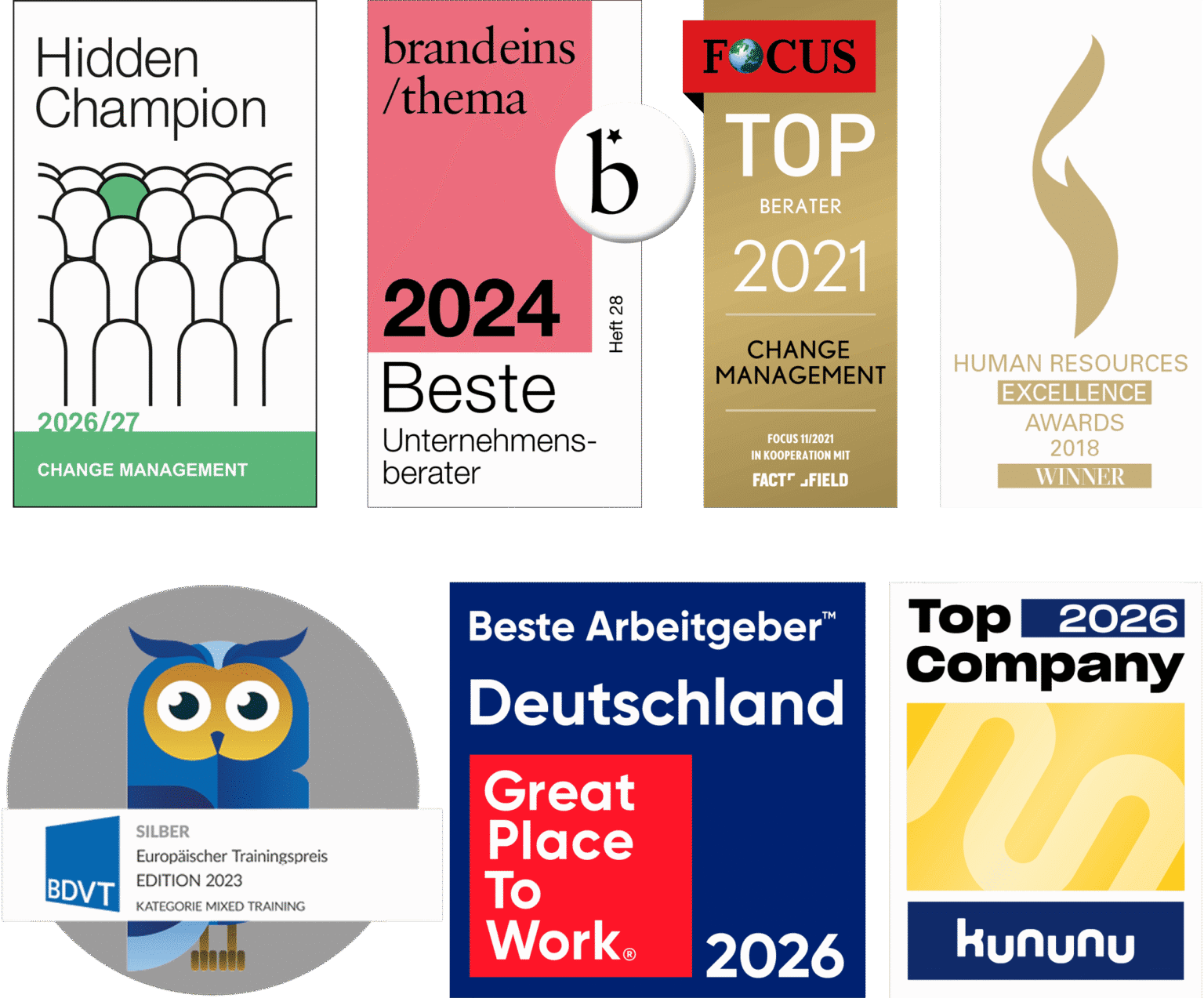
We're grateful for these awards
- CPC is a five-time No. 1 Hidden Champion for change management
- Year after year, brandeins/thema names us Germany's best management consultancy for change management
- We have been a Focus Top Consultant for many years
- Winner of the HR Excellence Award and the European Training Prize together with Deutsche Telekom and Lufthansa Technik
- We are No. 1 Great Place to Work in the 51–100 employees category and a Kununu Top Company.

The change management process – how we work
Change Initiation: how we start change projects
Our Change Initiation is the decisive first step in the change process. It lays the foundation for a clear, targeted transformation. Together with you we develop measures that are perfectly tailored to your company and your employees. In four effective modules we analyze the effects of the change, create a shared understanding of the change goals and bring your company's key people on board. In this way we build a stable change architecture that supports all further steps.
Change Initiation has proven itself many times in practice and is indispensable for every change initiative. With this offering we make the opportunities of change tangible and create a solid basis for acceptance and co-creation — so that your change succeeds.
1. Change Analysis
In the first step we analyze your previous change initiatives and assess current change processes.

1. Change Analysis
To do so, we interview leaders and relevant stakeholders, digitally or in person. Our change analysis consists of two elements:
1. Change Legacy Analysis: Which success factors from earlier projects can we use? Which mistakes should we not make again?
2. Change Impact Analysis: Which stakeholder groups and departments are affected by the change, and how does the transformation affect them? What has to be adapted — in leadership, teams or skills?
With these insights we identify the most important stakeholders in your company and plan appropriate measures, depending on how strongly they are affected and how great their need for information is. In this way we shape the change not with a watering can, but in a targeted and effective manner.
2. Change Story
The change story explains why the change is necessary and what effects it has on your company and your departments.
2. Change Story
It describes the target state as well as the path there. An effective change story is visionary, motivating, easy to understand and clearly formulated. In this way it provides orientation for all employees and fosters understanding.
Together with your sponsors and key players we develop a clear, inspiring target picture for the transformation. In doing so we reconcile the differing expectations of your leadership team to create a common basis for consistent communication.
At this step our change management ensures that everyone involved feels: something is running differently here — and better — than usual, and that is exactly why it will be successful.
3. Change Network Map
The success of a change project depends largely on the people involved.

3. Change Network Map
What is decisive is that we identify central stakeholders and find committed employees who actively help shape the change.
The Change Network Map makes the network of actors visible: it shows relationships between your leaders, project participants and other stakeholders. Using the map, local sponsors, change agents and influencers can be identified. And it helps to recognize areas with weaker connections and involve them deliberately in the exchange.
In addition, the attitudes of teams and individual employees can be captured to identify resistance early. Targeted measures are also derived and planned. At this step our change management lays the basis for an effective engagement process.
4. Change Architecture
Based on the results from the first three building blocks, we develop the change architecture.
4. Change Architecture
This is an integrated change plan that bundles all the derived measures. It comprises targeted change measures for different target groups, tailored to their needs, to foster acceptance and commitment.
Typical measures are: involving employees in shaping the solution, target-group-appropriate communication, training & enabling, as well as recognition & reward.
In the architecture we also define milestones and show what impact the measures are meant to have. It also serves to synchronize with the project plan. And through the concept of effective change steering and flexible change controlling, the architecture can be dynamically adapted to unexpected developments.
“With Change Initiation we offer you valuable support for the fundamental first steps in change management.”
Diana Herr, Senior Manager at CPC

Change Implementation: how we lead change projects to success
Following Change Initiation, the second step in the change process begins: Change Implementation. It aims to implement your change in a targeted way and lead it to lasting success. For this we offer you a package of six highly effective modules. With clear structures and targeted communication, we jointly create an environment in which change is lived. We strengthen your leaders as drivers, actively involve employees and convey new ways of working effectively.
With our Change Implementation we ensure that your change is implemented consistently, successfully and sustainably. Make your company fit for the future — with our Change Implementation, the proven approach for a successful, sustainable transformation!
1. Change Management Office
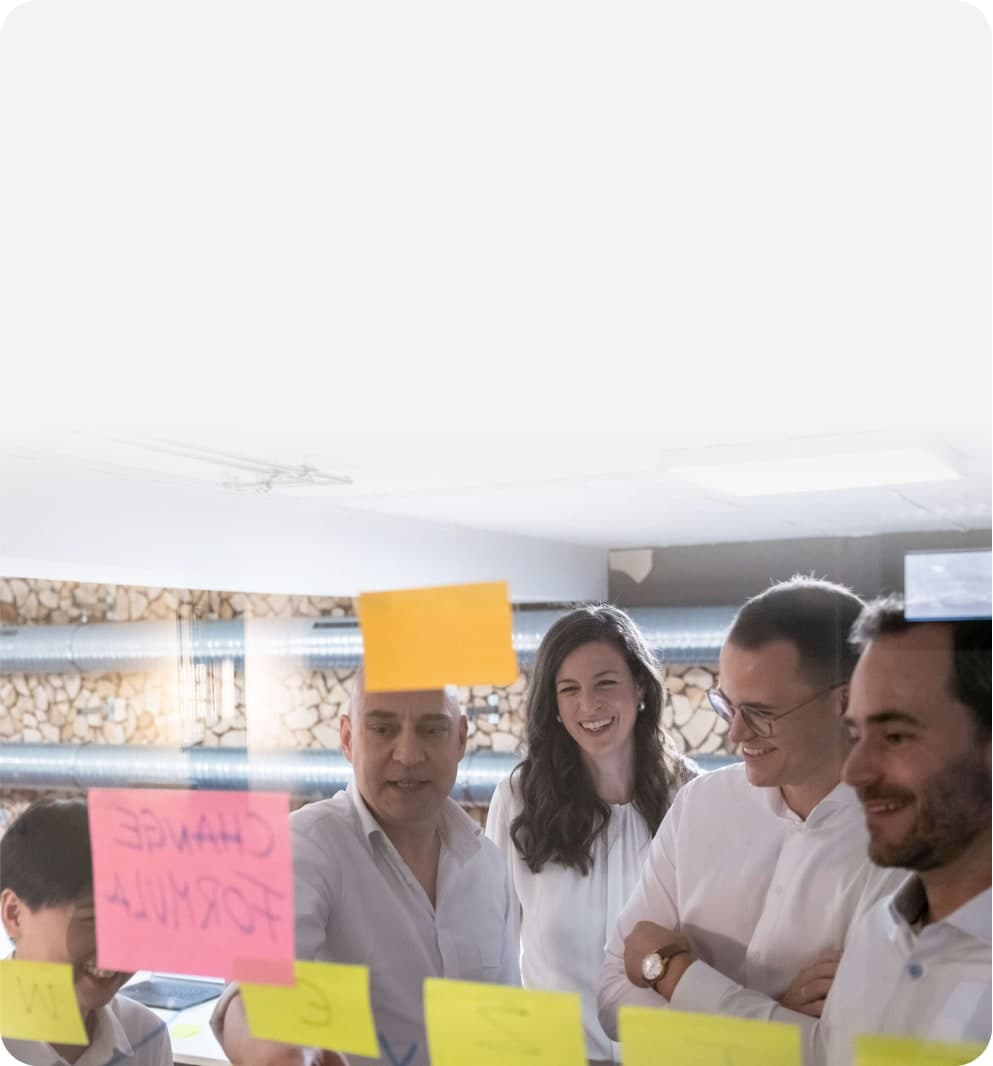
The Change Management Office (CMO) is the central point of contact for all questions relating to change management and the counterpart to project and program management.
1. Change Management Office
It is typically staffed with CPC change experts, steers the transformation and ensures acceptance and engagement among your employees.
The core tasks of the CMO include:
- Informing all employees not directly affected by the change early on, to prevent unnecessary resistance
- Defining and planning all change activities in close coordination with project and program management
- Carrying out change measures and monitoring their impact, as well as adjusting activities when situations change
- Stakeholder management and coordination of the change network
Through these measures the CMO ensures an effective and targeted change.
2. Change Communication
Based on the Change Impact Analysis, which shows how individual business areas are affected by the change, we develop communication measures.

2. Change Communication
Our communication campaigns provide stakeholders with relevant information, knowledge and updates about the change in a targeted way. In addition, all important content is available to employees at any time on the intranet. With visual change branding and merchandise items we increase identification with the change and encourage daily engagement with it.
To ensure effective communication, we develop a structured communication plan, establish effective channels and use target-group-specific micro stories. In this way we foster awareness and acceptance among your employees. We make successes large and small visible, prepare them as inspiring articles or videos and thereby motivate everyone involved for the change.
3. Change Leadership
Leadership is the key to the success of every transformation. The board, sponsors and leaders shape the change actively.

3. Change Leadership
They act as role models for the jointly developed target picture.
We support your leadership team in continuously keeping the focus on the change, living the target picture and acting as the central driver of the transformation.
In addition, we enable the leadership roles identified with the help of the Change Network Map to actively help shape and advance the change. We also establish a platform for exchange and communication in order to strengthen leaders in their task as effectively as possible, so they can guide their teams sustainably through the change.
4. Change Agent Network
Sustainable transformations need committed people on the ground. That is why we rely on change agents.

4. Change Agent Network
Change agents are employees who stand behind the change with enthusiasm. They act as coaches, trainers or multipliers and foster a positive change culture within their network.
Their tasks include supporting local management in implementing change measures, recognizing and overcoming obstacles, and communicating challenges and moods within the team. This makes them the central interface between the Change Management Office and the affected areas.
Building a strong change agent network is one of the most important and, at the same time, most demanding processes of our approach. That is why we are only satisfied once we have built a strong network and people are shaping the transformation successfully on the ground.
5. User Communities
User communities are networks of your employees who regularly exchange ideas about challenges and best practices.

5. User Communities
They support one another throughout the entire transformation and thereby foster the transfer of knowledge.
We support the build-up of these communities by having our experts moderate the exchange, present hands-on hacks and provide targeted support. We also supply the groups with relevant project information. Over time the participants take over the lead and independently share valuable knowledge among themselves.
The communities strengthen acceptance of and commitment to the change and form a central platform for exchanging proven practices. In this way a sustainable network emerges that drives the change forward.
6. Training & Enabling
Training & enabling is an important process for successfully guiding employees through change.

6. Training & Enabling
Often an “aha” moment is needed for them to accept new ways of working — especially when they have worked according to proven patterns for a long time.
Depending on the transformation goal, a lot can change for the affected employees: alongside new processes and tools, changes in thinking and behavior are often required too. Classic front-of-class training is not enough for this. Instead we rely on experiential formats that convey the new ways of working in a hands-on manner.
Our approach: we specifically determine the enabling needs and skills gaps, develop a tailored training plan for the various areas and implement the measures at the right time. Through continuous measurement of success, we ensure that your employees are optimally prepared for everything the change brings with it.
“Change Implementation is a package of six highly effective modules with which we lead your change project to success.”
Michael Babilon-Teubenbacher, Partner at CPC

The CPC change process:
these are the benefits we offer you

High acceptance within the company
Top management, leaders, project participants and end users stand behind the transformation and the associated technical and process changes.
Valuable change know-how
Leaders acquire practical change method knowledge that they can also apply in future projects. For example, they recognize resistance early and know which measures help.

Transparency of the effects
The effects of the transformation are transparent and target-group-specific. This makes it possible to provide and carry out the right information and enablement measures.

Informed employees
Communication tools that can be used long-term regularly inform leaders and end users and convey the knowledge needed for a successful transformation.

A strong change agent network
An organization-wide network of committed change agents actively supports the transformation and provides needs-based communication and enablement measures within the project.
Discuss your project with us
Let's discuss
your project with us!
The first step is easy — and don't worry: we won't send you dull newsletters or annoying promotional emails. Instead, we focus on what matters: your change goals and how we can move your business forward.

Step 1
Call back or email.
Within 24 hours we get in touch with you, capture your requirements and arrange an appointment with one of our experts.
Step 2
Free initial consultation.
In a video call you explain your project and discuss possible solution scenarios together with our expert.
Step 3
You decide how to proceed.
Proposal, pitch or project kickoff? You set the next steps.
Do you have questions about the change process?
A change process aims to make change effective, comprehensible and sustainable. This includes better acceptance, less resistance and clear orientation for everyone involved. At the same time, the organization should remain able to act and implement new requirements with confidence. Ideally, the change process leads not only to new structures but also to better collaboration.
Typical phases are analysis, planning, communication, implementation and anchoring. In the analysis it is clarified what should change. In the planning, goals and measures are defined. Communication and implementation ensure participation and practical relevance. In the final phase the change is secured in everyday life so that it does not exist only in the short term.
Those involved are usually leaders, project managers, employees and often external consultants too. It is important that the change is not steered solely from the top. The earlier those affected are involved, the better questions, concerns and practical problems can be taken into account. This increases acceptance and improves implementation in everyday life.
Among the biggest challenges are resistance, uncertainty, a lack of communication and a lack of clarity about goals or roles. Often a change process fails not because of the idea but because of the implementation. When employees don't see the benefit or don't feel involved, the willingness to change drops significantly. Good guidance is therefore decisive.
Success shows in whether the change actually works in everyday life. Important criteria are acceptance, the use of new processes, goal achievement and the stability of the implementation. Employee feedback and visible improvements in the workflow are relevant too. A change process is successful when the new solution is not only introduced but also lived.
Change agents act as coaches, trainers and multipliers and foster a positive change culture within their network. They support local management in implementing measures, recognize and overcome obstacles and form the central interface between the Change Management Office and the affected areas.
Yes. Our approach combines classic and agile project management with the demands of effective change processes and is compatible with common project management standards such as PMBOK® and PRINCE2®, as well as with agile methods.