

Change Management: Definition, Process and Models at a Glance
Markets, technologies and structures are changing faster today than ever before. For companies this holds great opportunity — provided they shape the change actively. This is exactly where change management comes in: it helps you plan change in a structured way, involve your employees and implement change successfully. Below you will learn what defines change management, which goals and methods lie behind it, which phases typical change processes go through and which success factors are decisive for a sustainable transformation. This way you approach your next transformation in a structured and confident manner.
Our Clients






























Introduction to change management
What is change management?
Change management, in German Veränderungsmanagement, covers all the tasks and measures that make a far-reaching change in an organization succeed. The goal: to anchor new strategies, structures, systems or processes successfully and lastingly in everyday work. The research institute Prosci® describes it as structured processes, tools and techniques. With them, companies manage the human side of change and achieve the desired business results.
Why is change management important?
Markets are changing faster today than ever before. Companies therefore have to stay flexible to remain competitive over the long term. Pure project management is often not enough for this. For the following reasons, professional change management safeguards the success of your project:

Protecting investments
New technologies only take effect once employees use them in their daily work.

More speed
Professional guidance noticeably accelerates implementation.

Genuine participation
Active involvement breaks down reservations early. Because it turns those affected into genuine co-creators.

More flexibility
Companies respond faster to new requirements and stay able to act.
“Change only takes effect once people live it day to day. Professional change management ensures that investments deliver real impact.”
Gunnar Schultze, Partner at CPC

The goals of change management
The overarching goal is a successful and lasting transformation. In doing so, our methodical guidance focuses on the following core goals:

Greater readiness
Acceptance of new processes rises noticeably, and a motivating working environment emerges.
Faster implementation
Teams learn new skills faster. As a result, you reach your strategic goals in less time.

Stable productivity
Well-prepared teams stay productive even during the change.

More innovation
A structured approach creates a lasting learning culture within the company.
The change management process
A successful change process never happens by chance. In practice it follows a clear sequence of five phases that build on one another.
Step 1. The change analysis(2–3 weeks)
It all starts with a clear picture of the starting position. That is why we capture the organization's current state precisely. Two central approaches are used here: the Change Legacy Analysis and the Change Impact Analysis.

Step 1. The change analysis(2–3 weeks)
- Change Legacy Analysis: A look at earlier projects shows what experience already exists. This helps you avoid old mistakes systematically.
- Change Impact Analysis: It shows exactly which departments and roles the changes affect, and how strongly.
Step 2. Target groups and story(4–6 weeks)
Change needs a clear direction and a sense of purpose. That is why, in this phase, we form a leadership coalition consisting of sponsors and the most important project stakeholders. Together, a motivating change story emerges.

Step 2. Target groups and story(4–6 weeks)
The change story answers three central questions:
- Organizational necessity: Why can't things stay the way they are? (The Burning Platform)
- Vision of the future: What awaits the organization after successful implementation?
- The path to the solution: How do we reach this vision together?
Step 3. Change plan and roadmap(2–3 weeks)
Based on the analyses, the strategic implementation plan emerges. A well-thought-out change architecture arranges all measures along a timeline and defines the right levers for each target group.

Step 3. Change plan and roadmap(2–3 weeks)
The change architecture covers the following points:
- Plan targeted communication channels for every level of the hierarchy.
- Design needs-based training and courses for everyday practice.
- Agree clear responsibilities and measurable interim goals.
Step 4. Communication and enablement(6–9 months)
In this phase we actively carry the plan into the organization. Clear communication, strong leaders and hands-on training bring the new ways of working into everyday life.

Step 4. Communication and enablement(6–9 months)
Three levers work together here:
- Foster awareness and dialogue through communication, campaigns and formats.
- Leaders act as role models; networks of multipliers spread acceptance widely.
- Hands-on training for the teams so they can apply the new ways of working confidently.
Step 5. Steering and anchoring(Ongoing)
So that changes take lasting effect, we carry out the planned change measures or adapt them as needed. In this way we anchor the change permanently as the new reality.

Step 5. Steering and anchoring(Ongoing)
These measures secure long-term impact:
- Coordinate all activities through the Change Management Office (CMO).
- Ensure transparency through continuous controlling.
- Gather systematic feedback from the business units.
Change management models in comparison
Change management models break complex processes down into comprehensible phases. Behind this lies a simple principle: change succeeds better when everyone involved knows where they stand and what comes next. There is no universally right model — what matters is that it fits your company and your goals.
The 5 change management models compared side by side:
Typical challenges in the change process
Every transformation brings challenges with it. Concerns or open questions within the teams are completely normal. Don't see them as a disruption, but as valuable pointers to the needs and expectations of your employees. Typical hurdles and how to handle them correctly:
“Concerns within the team are normal — those who take them seriously turn hurdles into the path to success.”
Michael Kempf, Partner at CPC

The change curve: emotional phases in the change process
The change curve, after Kübler-Ross, describes employees' emotional reactions to change. Transformations affect not only processes and structures, but above all people. Those who know these phases guide change more deliberately.
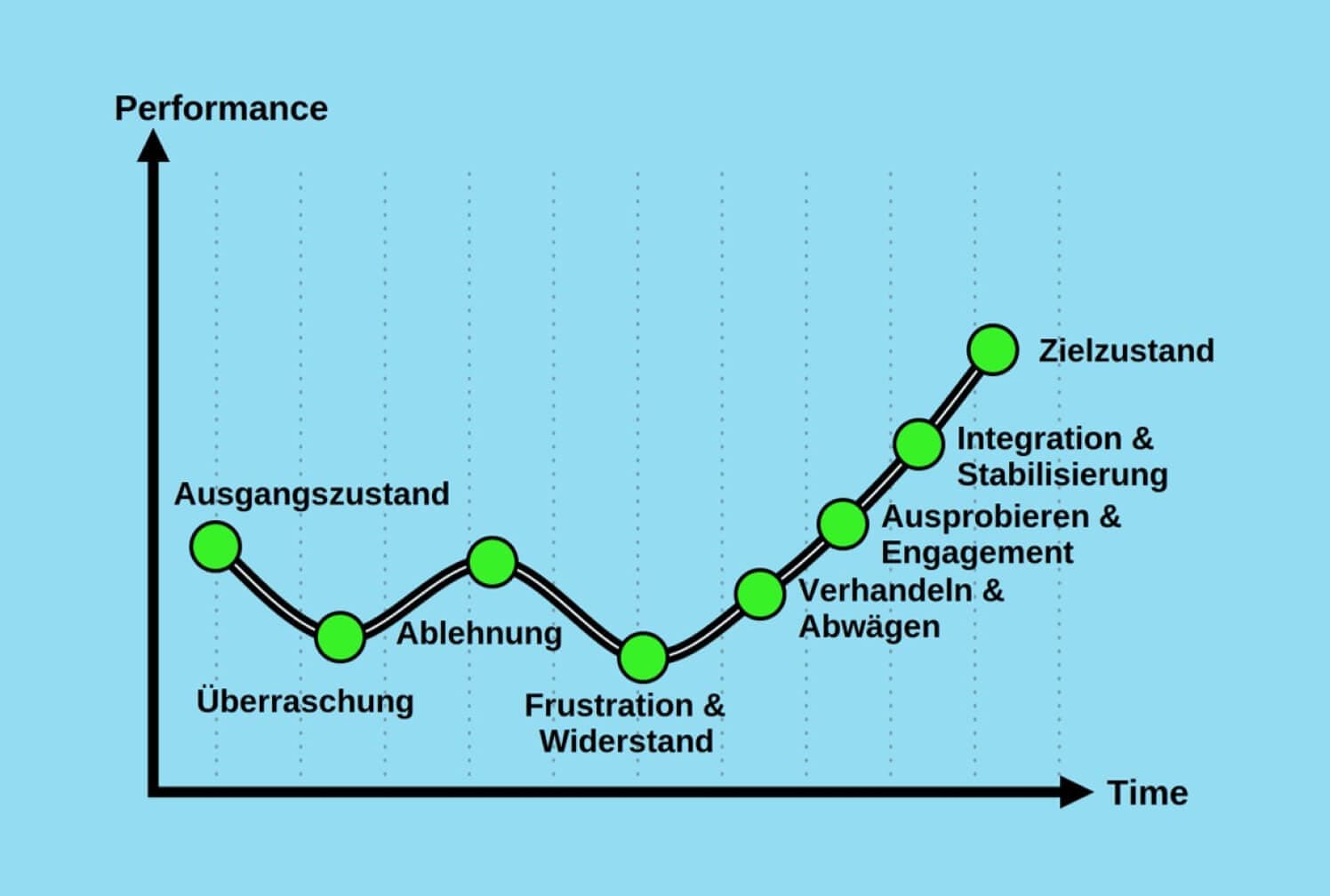
The resistance phase is usually the most critical stage in the change process. You can read how psychological resistance can be overcome systematically on the page about the new change formula.
Success Factors for Change Management
Whether introducing AI, reorganizing or shifting culture: the success of change management projects depends largely on the consistent application of proven methods.
The change story as the communicative backbone
The change story conveys the meaning of the change. It explains why it is necessary, what goal it pursues and what the path there looks like. A clearly formulated story creates orientation and trust. It thus forms the basis of internal communication, from the first town hall meeting to the completion of the project.

Change Impact Analysis: who is affected by the change, and what has to change?
The Change Impact Analysis examines the effects of an initiative systematically. It shows which target groups the change touches and which skills or structures have to adapt. In this way you identify critical areas early and address them deliberately.
Further proven success factors:
- Involving top management as visible supporters and role models
- Stakeholder analysis to identify influential groups early
- A clear target vision with consistent communication
- A roadmap with a timeline and measurable stages for the entire process
- Building a guiding coalition — a core team of leaders and opinion formers
- Making early successes visible to strengthen motivation
- Identifying and involving change agents as internal multipliers
- Establishing feedback mechanisms to measure acceptance
- Lastingly anchoring the new ways of working through a Change Management Office
Change management in practice:
The CPC AG approach
Successfully shaping a transformation depends largely on choosing the right partner. CPC AG combines decades of experience with scientifically grounded, modern methods of organizational development.
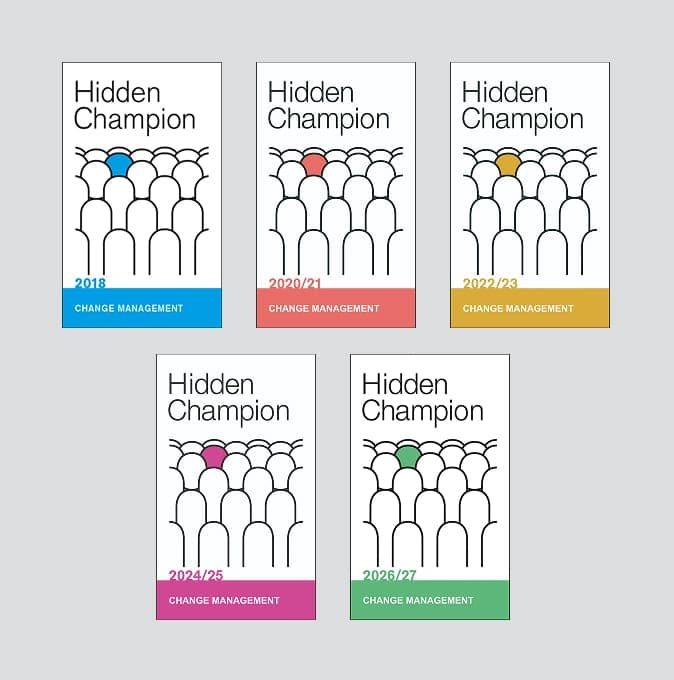
Five-time Hidden Champion
Independent experts have named us the number one Hidden Champion for change management five times in a row.
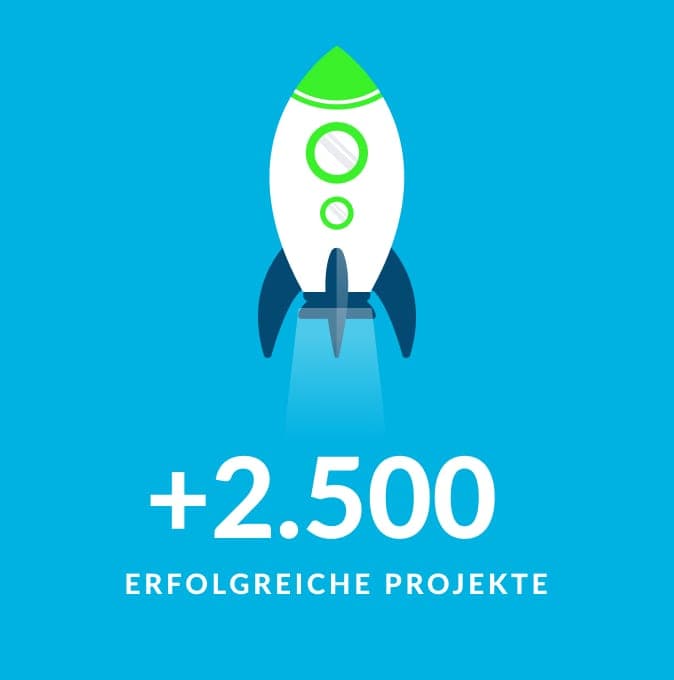
Over 2,500 successful projects
We have been guiding DAX corporations and mid-sized companies safely through far-reaching change for more than 30 years.
Our CPC Change® method
We use a proven set of methods and flexibly adapt it to the needs of your company.
Transformation Consulting
Large transformations involve a deeper change that affects the entire company. This calls for staying power and our proven approach developed for precisely this purpose.
“Transformation takes more than good planning. It takes experience, method and a partner who brings change safely into implementation.”
Jördis Andersson, Partner at CPC

Specialization in complex industries and AI transformations
Every industry has its own challenges, cultures and drivers of change. That is why we tailor our approach precisely to your conditions — whether in the automotive industry, the energy sector, pharma or the financial sector.
A particular focus today is on artificial intelligence. As the only consultancy in the market to offer AI consulting and change management from a single source, we support you not only with the technical rollout. Above all, we support you in developing a future-ready AI culture within your team.
Key competencies for leaders in change
Leaders are at the heart of every change. Their task is to live the change convincingly, take concerns seriously and set a clear direction. What matters is not announcing new measures, but building trust.
That is why we support companies specifically with leadership development that is tailored to the demands of transformation projects.
The role of leaders
in change management

Leadership in change processes
Leadership in change processes
Leaders are the most important guides during phases of change. Their attitude significantly influences the organization's willingness to take new paths. In this way they reduce uncertainty and create orientation.
Good leadership means not just giving instructions but sharing visions. Empowered leaders present change as an opportunity. This creates a shared understanding and a strong sense of togetherness within the company.

Communication and motivation
Communication and motivation
Open communication is the heart of successful leadership. Managers should not only speak but, above all, listen attentively. Appreciative feedback conversations are a proven instrument for this in the change process.
Motivation arises from experiencing self-efficacy and personal growth. When leaders deliberately create space for independent action, engaged and high-performing collaboration develops.

The responsibility of management
The responsibility of management
Management bears the strategic responsibility for the entire initiative. It secures the resources and defines clear conditions for the process. This demanding leadership role must be actively fulfilled in everyday work.
In addition, the leadership level identifies conflicting goals early and resolves them constructively. A professionally facilitated alignment process strengthens the trust of the entire organization.

Developing change leadership
Developing change leadership
The ability to lead through change can be trained deliberately. In hands-on coaching we convey modern leadership methods for agile working environments. In this way you prepare your managers optimally for future transformations.
Certified further training forms a valuable building block here. Leaders acquire proven skills for daily practice. This secures the quality of leadership within the company for the long term.
“Leadership in change means providing orientation, strengthening trust and winning people over to new paths.”
Carina Throne, Senior Manager at CPC

Change management in the digital age: AI and SAP S/4HANA
Artificial intelligence is one of the central drivers of today's transformations. It often changes processes, roles and decision paths faster than organizations can adapt. That is why change management becomes a decisive success factor in AI rollouts.
Technology only unfolds its full benefit once people understand it and apply it in everyday work. Without accompanying change work, potential often remains untapped. That is why the close connection of technological consulting and structured change management is the key to success.
The same applies to SAP S/4HANA: A survey among SAP customers shows that 62% of the challenges in these projects are organizational in nature. Accordingly, we closely interlock technical implementation and change methodology.
For companies that want to build the capacity for change as a lasting competency, agile, adaptive transformation consulting is the right choice. This approach combines technology know-how with deep change expertise. This way you achieve sustainable results in a constantly changing environment.
Let's discuss
your project with us!
The first step is easy — and don't worry: we won't send you dull newsletters or annoying promotional emails. Instead, we focus on what matters: your change goals and how we can move your business forward.

Step 1
Call back or email.
Within 24 hours we get in touch with you, capture your requirements and arrange an appointment with one of our experts.
Step 2
Free initial consultation.
In a video call you explain your project and discuss possible solution scenarios together with our expert.
Step 3
You decide how to proceed.
Proposal, pitch or project kickoff? You set the next steps.
Do you still have questions about change management?
Change management aims to shape change effectively and lastingly. It creates orientation, encourages participation and strengthens an organization's ability to implement new things successfully. In doing so, leaders, teams and structures are aligned so that change releases motivation and performance instead of triggering uncertainty.
A successful change process runs through clear phases: analysis and target picture, target groups and change story, change plan and roadmap, communication and enablement, and steering and anchoring. It is accompanied by continuous controlling in the Change Management Office. Smaller projects last 3 to 6 months, comprehensive transformations 12 to 24 months.
Project management steers tasks, resources, schedules and budgets. Change management guides the people the change affects. Both disciplines complement each other and are closely interlocked in successful transformations. Those who only do project management deliver on time, but without acceptance. Those who only do change management win hearts, but without a structured plan. That is why CPC combines both perspectives from the very start in every project.
Success can be measured with defined KPIs: acceptance rates, implementation progress and degree of goal achievement are among the most important metrics. Added to these are leaders' engagement scores and training completion rates. Ongoing controlling through a change office ensures transparency and enables early adjustments.
Digital transformation changes roles, processes and culture at the same time. Change management creates understanding, enables teams and accelerates the adoption of digital solutions. In this way technologies unfold their full value in day-to-day business. According to a survey of SAP customers, 62% of the challenges in S/4HANA projects lie on the human side, not the technical one.
Artificial intelligence is changing working processes in almost every industry. That is why every AI rollout needs professional change management. It creates acceptance, enables employees and secures the ROI of the investment. CPC AG combines AI consulting with change expertise for holistic guidance.