

 Sebastian KeimJune 18, 2026
Organisational structure describes the hierarchical framework of a company. It governs who takes on which tasks, who makes decisions and how information flows. It is depicted in the organisation chart, which makes roles, departments and reporting authority visible.
Organisational structure forms the structural foundation of every company. Every organisation needs a clear order: who is responsible for what? Who takes which decisions? And who reports to whom? Organisational structure provides exactly this framework. It creates clarity, avoids duplicated responsibilities and enables focused leadership. Without this underlying structure, gaps, conflicts and delays emerge, particularly when a company is growing or changing.
Contents
What forms of organisational structure are there?
The forms of organisational structure can be distinguished along two dimensions: line systems govern the flow of authority, while structuring principles determine the criteria by which departments are formed. Both dimensions shape the organisation chart and, with it, day-to-day working life. Choosing the right form is not a purely theoretical question; it directly influences how quickly decisions are made, how well teams work together and how flexibly the company responds to change.
Which organisational structure fits your company?
How does your company make decisions?
How are your specialists involved?
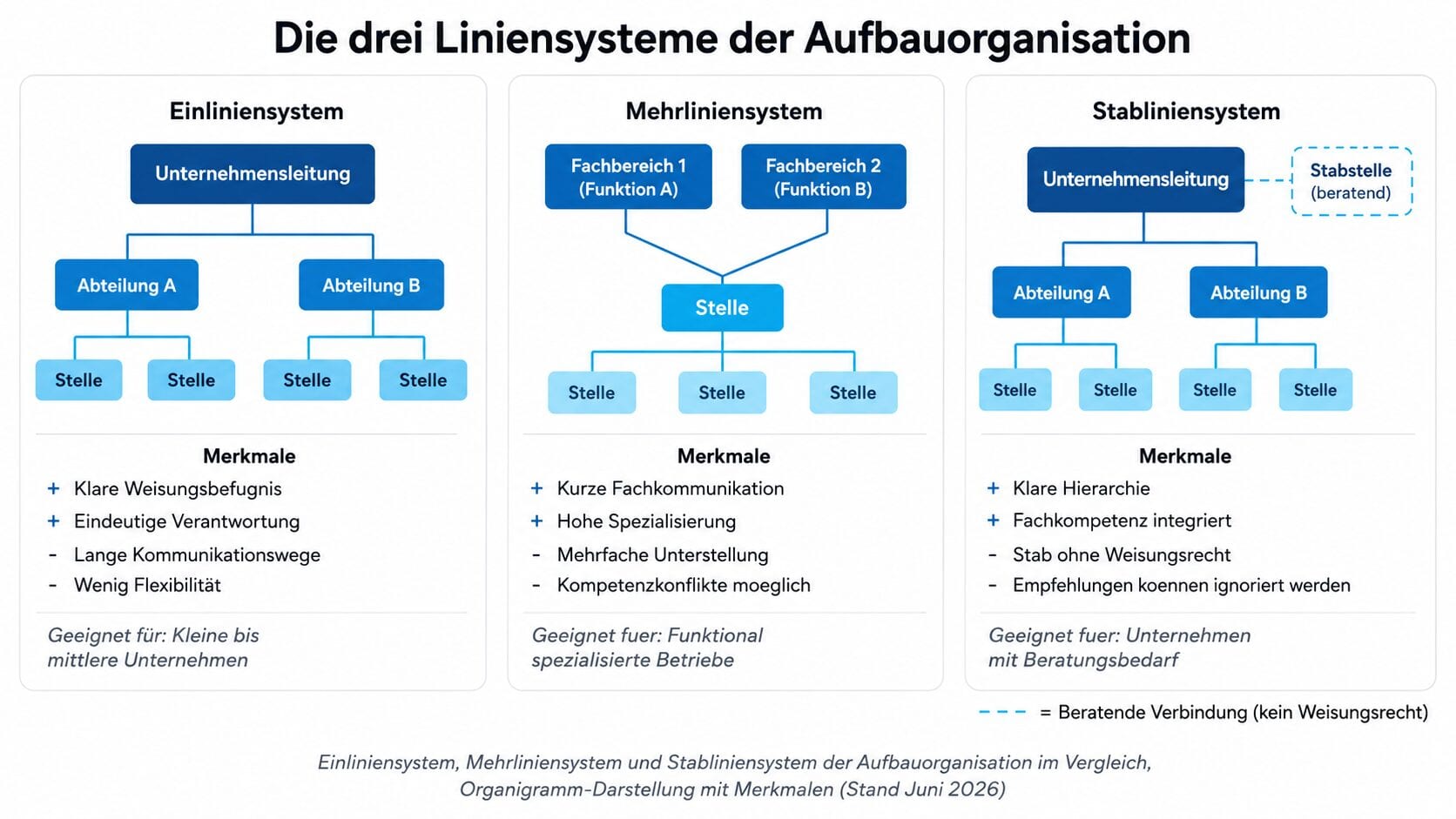
Single-line, multi-line and line-and-staff systems
The single-line system, also known as line organisation, places every role under exactly one superior management position. Every employee therefore has precisely one manager from whom instructions come. This creates clear responsibilities and prevents contradictory directives. The drawback: with many hierarchical levels, decision paths become long. Information travels vertically through several tiers before it arrives.
The multi-line system, by contrast, allows several superiors to issue instructions directly to the same role. An employee in production may, for instance, receive instructions from both the production manager and the quality manager. This can speed up decisions, but it carries the risk of conflicting requirements. The system therefore demands clear rules on who takes precedence in which situation.
The line-and-staff system supplements a classic line with specialised staff units that hold no formal authority. A controlling unit advises the executive board but issues no instructions to the line itself. Decision paths stay lean while specialist expertise is fed in where it is needed. Staff units are particularly well suited to legal matters, strategic planning or quality assurance, wherever concentrated expert knowledge is called for.
Functional, divisional and matrix organisation
The functional organisation structures the company by activity: procurement, production, sales, finance. Each department develops deep expertise in its own field. This is particularly advantageous in stable markets where standardisation and efficiency count. A mid-sized manufacturer with a uniform product portfolio, for example, benefits considerably from this structure. The typical challenge: departmental thinking, so-called silos, can make cross-functional collaboration harder.
The divisional organisation structures the company by product, market or region. Each division carries its own bottom-line responsibility and has its own resources. A consumer goods manufacturer with divisions for food, personal care and cleaning products is a classic example. This form increases market proximity and flexibility, but often leads to duplicated structures: each division maintains its own support functions such as HR or IT.
The matrix organisation combines both axes. Employees report simultaneously to a functional lead and to a product or project lead. An engineer reports to the head of development and to the project manager of the current assignment. This encourages knowledge sharing and flexibility, but calls for clear ground rules on who has the final say when conflicts arise. According to a McKinsey study, more than 60% of matrix initiatives fail not because of the structure itself but because of missing processes for resolving conflicts over remit.
The essentials at a glance
-
- Single-line system: one manager per role, clear but slow
- Multi-line system: several managers per role, fast but prone to conflict
- Line-and-staff system: advice without formal authority, efficient use of expertise
- Functional organisation: structured by activity, specialisation, risk of silos
- Divisional organisation: structured by product/market, market proximity, duplicated structures
- Matrix organisation: two axes combined, flexible, coordination-intensive
Advantages and disadvantages of the main forms at a glance
| Form | Advantages | Disadvantages |
|---|---|---|
| Single-line system | Clear instructions, unambiguous accountability | Long decision paths |
| Multi-line system | Fast specialist decisions | Possible conflicts of authority |
| Line-and-staff system | Expertise without inflating the line | Staff units without formal power |
| Functional organisation | High specialisation, efficiency | Departmental silos, limited market flexibility |
| Divisional organisation | Market proximity, clear bottom-line accountability | Duplicated structures in each division |
| Matrix organisation | Knowledge sharing, flexibility | High coordination effort |
Modern and agile additions
Classic forms are increasingly being supplemented by agile structures. Squad models, made famous by Spotify, organise cross-departmental teams around a clear product or customer goal. Holacratic approaches distribute decision-making authority consistently across self-organising circles rather than a classic hierarchy. These models, however, always build on the basic forms described above.
Anyone introducing agile structures must therefore first clarify which base structure forms the foundation. Without a clear organisation chart, there is no anchor point for any change.
Which form is the right fit depends on company size, strategy and market environment. Growing companies often combine several principles. What matters above all is that tasks, authority and accountability align for every role, what management theory calls the congruence principle.

Organisational structure and process organisation: what is the difference?
Organisational structure and process organisation complement one another. Organisational structure determines who does what. Process organisation governs when and how tasks are carried out. Both perspectives describe the same company from two angles: once as a static framework, once as a dynamic chain of processes.
Static framework and dynamic processes
Organisational structure is the organisation chart: it shows which roles and departments exist, who reports to which manager and what reporting authority is in place. This framework rarely changes, usually only in the event of growth, restructuring or a strategic realignment.
Process organisation, by contrast, describes the processes that run within this framework. It sets out the order in which tasks are completed, which information is passed on and when, and who carries out which steps. Process organisation is often visualised in process maps or flow charts.
A concrete example illustrates the relationship: the organisation chart shows that HR is responsible for hiring new employees. Process organisation then describes the exact process, from the reported requirement through the job advertisement, interview and decision to the signed contract.
Without a clear organisational structure, accountability is missing. Without sound process organisation, implementation stalls.

Why both perspectives matter together in transformations
Change initiatives almost always affect both dimensions. Introducing new technologies or merging departments changes structures and processes at the same time. Adjusting only the organisational structure while leaving the processes untouched often creates new friction. Conversely, process improvements have no effect if the underlying responsibilities remain unclear.
From CPC practice
In large transformation programmes such as an SAP S/4HANA implementation, both sides frequently change at once. New processes call for new roles, and new roles require adapted structures. In our experience, companies underestimate this connection: they focus on the technical implementation and overlook the fact that around 62% of the challenges in such projects stem from human and organisational factors. That is why we analyse organisational structure and process organisation together and align them with the strategy. The result is structures that carry change rather than slow it down.
According to the organisational theory of Erich Kosiol, task analysis and task synthesis form the basis of both perspectives. First, overall tasks are broken down into sub-tasks. They are then brought together into roles, departments and processes. Anyone planning a reorganisation should therefore consider both dimensions early and design them jointly. Our organisational design connects precisely these perspectives. Our change process ensures that people support the change.
Organisational structure and process organisation compared
| Characteristic | Organisational structure | Process organisation |
|---|---|---|
| Key question | Who does what? | When and how is it done? |
| Character | Static, structural | Dynamic, process-based |
| Representation | Organisation chart | Process map, flow chart |
| Frequency of change | Rare (during restructuring) | Regular (during process improvements) |
| Typical elements | Roles, departments, hierarchy | Steps, sequences, information flows |
The two dimensions influence one another. A well-designed organisational structure creates the conditions for smooth processes. And efficient processes make it transparent where structures need to be adjusted. Change succeeds when employees are actively involved, because people are the key to success.
FAQ: frequently asked questions about organisational structure
What are the guiding principles of organisational structure?
The most important principles are fitness for purpose, clarity, economy and stability. Every role needs clearly defined tasks, authority and accountability. Added to this is the congruence principle: tasks, authority and accountability must match for every role. Whoever carries accountability must also hold the corresponding decision-making authority. Where this congruence is missing, blockages and frustration follow. This is how companies avoid friction and build reliable collaboration.
When should a company change its organisational structure?
An adjustment makes sense in the event of strong growth, new markets, mergers, technological upheaval or a change of strategy. It is also worth taking a critical look at the structure when decisions take too long, responsibilities become unclear or employees are frequently referred to the wrong contact. Another sign: if new projects regularly fail because nobody takes overall ownership, the organisational structure is often part of the problem. A modern organisational structure supports the strategy, eases day-to-day collaboration and creates room for change.
How do you create an organisation chart?
An organisation chart is created in three steps. First, all roles and departments are recorded in full. Second, reporting lines and formal authority are defined: who reports to whom, and who holds which decision-making powers. Third, the structure is visualised as a tree diagram or network. Clear labelling matters here, with the job title, area of responsibility and, where appropriate, the name of the post holder. The organisation chart should be updated immediately after any restructuring so that it remains a reliable point of reference.
What does redesigning an organisational structure cost?
Blanket figures are of little use, because the effort involved depends heavily on company size, complexity and the scale of the change. A mid-sized company with 200 employees planning to reorganise a single department has very different needs from a corporate group converting a divisional structure into a matrix. One thing is clear: the indirect costs of not reorganising, lost efficiency, staff turnover, decision-making blockages, in many cases exceed the investment in professional support. If you have specific questions about your plans, please get in touch with us directly.
How does CPC support the redesign of an organisational structure?
CPC supports companies from start to finish, because people are the key to success. In our organisational consulting we analyse the current structure, develop a target picture together with managers and teams, and support implementation step by step. Our organisational design is combined with our proven change process, which has stood the test of more than 2,500 projects. The result is robust structures that work in practice and are carried by the people in the organisation.
Would you like to redesign your organisational structure?
Our consultants analyse your structure and guide you step by step to the right organisational form.