
 Sebastian KeimJune 17, 2026
Companies today face growing complexity. Markets shift quickly, projects are increasingly interdisciplinary and specialist knowledge has to be deployable at short notice. The matrix organisation is one answer to this. It combines functional expertise with project-based steering, creating a flexible and efficient organisational form. Its success, however, depends decisively on how well people cope with the new structure. This is precisely where professional change management comes in.
Matrix organisation: a matrix organisation is a multi-dimensional organisational form in which employees have two superiors: a functional department head and a project or product owner. This structure combines specialist expertise with a project focus and enables efficient use of resources. It is a form of multi-line system and is particularly common in complex, project-driven companies.
Contents
- What is a matrix organisation?
- Variants of the matrix organisation: weak, balanced and strong
- Advantages and disadvantages of the matrix organisation at a glance
- Introducing a matrix organisation: why change management decides the outcome
- FAQ: frequently asked questions about the matrix organisation
What is a matrix organisation?
A matrix organisation is an organisational form with two overlapping reporting lines. Employees have a functional superior, usually the head of a department such as marketing, IT or sales, and at the same time a second superior at project or product level. This dual structure makes the matrix organisation a multi-line system and sets it clearly apart from classic, hierarchical organisational forms.
According to the PMBOK Guide, the matrix organisation is one of the most important structures in modern project management. It allows companies to bring together expertise from different areas and focus it on projects. This makes it particularly widespread in DAX-listed companies and in the German Mittelstand, wherever complex undertakings have to be steered across departmental boundaries.
How it differs from the classic line organisation
In a classic line organisation, also known as a single-line system, every employee has exactly one superior. Decisions follow a strict hierarchy. This provides clarity, but it also creates silos. Specialist departments often work alongside one another rather than with one another. Cross-project collaboration has to be coordinated laboriously.
The matrix organisation solves this problem structurally. It adds a second line of leadership without dissolving the functional departments. This is why it is also referred to as a multi-dimensional organisational structure. It typically emerges when companies grow, become more international or work increasingly in projects. Corporations such as Siemens, Bosch and ABB have relied on matrix structures for decades because they make expertise globally accessible while still allowing local steering.
Design and characteristics: how a matrix organisation works
The design of a matrix organisation follows a clear principle: the horizontal axis holds the functional areas, the vertical axis the projects or product lines. Employees are thereby assigned to two superiors. The department head usually holds line management responsibility, deciding on development, pay and long-term career planning. The project owner, by contrast, steers the professional work within the project.
This division of responsibilities makes it possible to deploy resources flexibly. A developer can, for instance, work for their own department and for a client project at the same time. A sales colleague brings their market knowledge into an interdisciplinary product team. The result is a structure that uses expertise efficiently while accelerating project results.
What matters here is a clear distinction between professional and line management authority. Without that distinction, conflicts arise over who takes which decisions. Successful matrix organisations settle this question bindingly from the outset, and it is one of the most important success factors.
Variants of the matrix organisation: weak, balanced and strong
The essentials at a glance
- Weak matrix: the functional areas dominate and the project manager coordinates
- Balanced matrix: function and project hold equal authority
- Strong matrix: the project manager leads the project with full responsibility
The matrix organisation exists in three forms, which differ above all in how power is distributed between function and project. The PMBOK Guide describes these variants as a central selection criterion for companies. Choosing the right variant depends on corporate culture, project volume and the maturity of the leadership team.
Which matrix organisation fits your company?
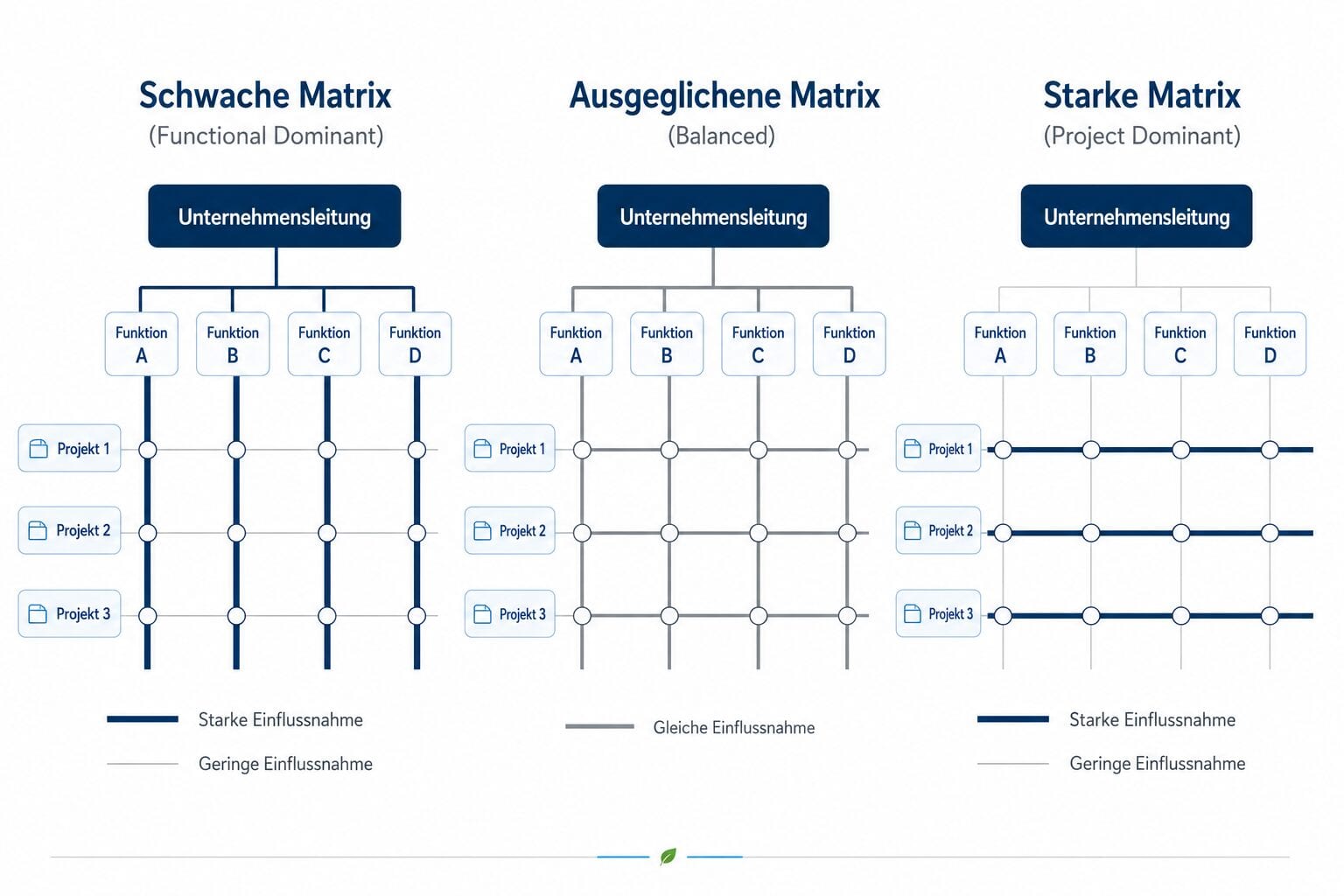
Three variants of the matrix organisation compared: weak, balanced and strong matrix with different distributions of power.
In the weak matrix, the functional line remains strong. The project manager acts more as a coordinator and has limited decision-making authority. They align, plan and inform, but rarely take independent decisions on resources or priorities. This form suits companies that want to extend their classic line organisation only slightly, without shifting fundamental power relationships.
The balanced matrix distributes responsibility evenly. Functional leads and project managers take decisions jointly. This variant is demanding, because it requires clear ground rules and mature leaders. Both sides have to cooperate rather than compete. Implemented well, it combines the best of both worlds: depth of expertise and project focus.
In the strong matrix, the project manager takes on primary responsibility, steering budget, timelines and team composition. The functional areas primarily supply resources and expertise. This form is particularly common in project-centred industries such as automotive, pharmaceuticals and energy, where projects run for months or years and involve large investments.
Which variant suits your company?
Choosing the right form is not a purely structural question but above all a cultural one. Companies with a strongly hierarchical culture often choose the weak matrix as a first step. It changes the way people work together without fundamentally unsettling established power structures, which makes acceptance easier.
Companies that already work in a project-oriented way and have experienced project managers benefit more from the strong matrix. It enables fast decisions and clear accountability, decisive advantages in highly competitive markets.
We typically support companies in choosing the right variant and introducing it step by step, because moving too quickly to a strong matrix can trigger resistance that cancels out the benefits of the new structure.
Advantages and disadvantages of the matrix organisation at a glance
Every organisational form has its strengths and its limits. The matrix organisation offers clear advantages, but it also brings challenges that companies should manage deliberately.

| Advantages | Challenges |
|---|---|
| Efficient use of resources across departments | Greater need for alignment and communication |
| Flexibility as project requirements change | Potential role conflicts between the two superiors |
| Optimal use of specialist expertise | Clear accountabilities require discipline |
| Better communication between functions | More complex decision paths |
The advantages in detail
Efficient use of resources: in a functional organisation, specialists often sit in silos. A data analyst works exclusively for the marketing department, even though the development team urgently needs their expertise. The matrix organisation solves this problem. Resources are deployed as needed, where their value is greatest. This lowers costs and increases the utilisation of skilled staff.
Flexibility and adaptability: projects begin and end. Teams form and disband. The matrix organisation accommodates this dynamic without having to rebuild the entire structure each time. New requirements are met by reallocating resources rather than by reorganising.
Better communication: because employees from different functions work together on projects, informal networks emerge. Engineers speak directly with sales, finance specialists exchange ideas with IT. This connectedness increases mutual understanding and speeds up everyday decisions.
Recognising and managing the challenges
The most common challenge in a matrix organisation is the so-called two-boss conflict. When the functional lead and the project manager set different priorities, employees are caught in the middle. Whose instruction applies? Whose goals matter more? If this question goes unanswered, frustration follows. According to a study by GPM, the German association for project management, more than 60% of employees in matrix organisations regularly experience conflicting priorities.
The greater communication effort is another reality. Alignment meetings, handovers and coordination sessions increase. That is not a flaw in the structure but its price. This effort pays off when the structure is well led. It becomes a burden when clear ground rules are missing.
In our experience, these challenges can be reduced considerably when companies invest from the outset in clear role agreements, leadership development and structured change management. Structures alone do not create collaboration; people do.
Introducing a matrix organisation: why change management decides the outcome
Introducing a matrix organisation is more than a structural rebuild. It changes how people work together, how decisions are made and how responsibility is shared. This is exactly where the difference lies between a successful transformation and a reorganisation that exists only on paper. Our experience from more than 2,500 change projects shows that change succeeds when employees are actively involved.
Read more: change management definitions and fundamentals

Typical resistance arises because employees suddenly report to two superiors. They ask themselves: who decides? Who assesses my performance? Who protects me when there is a conflict? If these questions go unanswered, uncertainty and friction follow. Clear ground rules, transparent communication and well-prepared leaders are therefore decisive.
A professional change process starts early. It begins with a clear change story that makes the purpose of the new structure comprehensible. Leaders are strengthened in their new role, because in a matrix organisation they have to cooperate rather than dominate. Change agents in the business areas carry the change into the teams. That is how a complex structure becomes an organisational form that people actually live.
According to the Project Management Institute, the success of a matrix organisation depends above all on the maturity of the leadership culture. Those who take this seriously invest not only in structures but also in people.
Why matrix rollouts fail and how change management counteracts it
Many matrix implementations follow the same pattern: top management signs off the new structure, organisation charts are updated, and six months later most people are still working exactly as before. The reasons for this are well known.
First, a convincing rationale is often missing. Employees do not understand why the change is necessary. The change story is absent or remains abstract. Second, leaders are not sufficiently prepared for their new role. In a matrix organisation, department heads have to share resources and give up power. That is hard when nobody explains why it is a good thing and how it works. Third, conflicts between functional leads and project managers are ignored rather than mediated. They continue to simmer and poison the atmosphere.
Professional change management addresses all three points. It creates clarity about the purpose of the change, equips leaders for their new tasks and establishes mechanisms for resolving conflict. This includes regular acceptance surveys, targeted communication measures and structured formats for cross-departmental collaboration.

From practice: how CPC supports the move to a matrix organisation
Five steps to a successful matrix organisation
- Develop a clear architecture: roles, accountabilities and decision paths are unambiguously defined
- Formulate a change story: the purpose and benefits of the new structure are communicated comprehensibly at every level
- Equip your leaders: functional leads and project managers are trained in cooperation, conflict resolution and joint steering
- Build a change agent network: key people in the business areas actively carry the change into the teams
- Measure acceptance and adjust: regular surveys show where fine-tuning is needed
In one concrete example, we supported a mid-sized industrial company with around 4,000 employees in introducing a strong matrix organisation. The biggest hurdle was initially not the structure but the concern among many employees that they would lose their bearings. Through early involvement, clear communication and targeted leadership development, acceptance rose markedly within nine months. Today the company works successfully in the new structure.
A second example comes from the energy sector: a utility with more than 8,000 employees wanted to improve collaboration between regional units and central specialist departments. The balanced matrix organisation was the structural answer. The decisive success factor was a change agent network of more than 40 managers who carried the change into their teams. Within a year, satisfaction with cross-functional projects rose measurably.
These experiences show that a matrix organisation does not run itself. It needs a solid foundation of clear structure, capable people and accompanying change management. You will find further information in our sections on organisational design and our change process.
FAQ: frequently asked questions about the matrix organisation
What is a matrix organisation, put simply?
A matrix organisation is an organisational form in which employees have two superiors: a functional department head and a project or product owner. This multi-dimensional structure combines specialist expertise with a project focus and enables efficient use of resources across departmental boundaries.
When is a matrix organisation the right choice?
The matrix organisation is particularly suited to companies with complex projects that need to combine expertise from different areas. These include DAX-listed companies, mid-sized firms in pharmaceuticals, automotive and energy, and project-oriented service providers. It requires a mature leadership culture and clear ground rules. It is less suitable for small companies with flat structures or for industries in which projects rarely cross departmental boundaries.
What are the typical challenges of a matrix organisation?
Typical challenges are role conflicts between the two superiors, a greater communication effort and unclear accountabilities. According to GPM, more than 60% of employees in matrix organisations regularly experience conflicting priorities. These risks can be reduced considerably through a clear architecture, well-prepared leaders and professional change management.
How does a matrix organisation differ from a project organisation?
In a pure project organisation, employees work on one project only and report exclusively to the project manager. Their membership of a specialist department recedes or disappears entirely. In a matrix organisation, employees remain part of their department. They therefore have two superiors and can be deployed flexibly between function and project. The matrix organisation is thus more permanent and structurally more stable than a pure project organisation.
How do you introduce a matrix organisation successfully?
Successful implementations begin with a clear change story, a well-considered architecture and capable leaders. Employees are involved early, roles are clearly defined and acceptance is measured regularly. Professional change management is the decisive success factor, not the structure chart alone. In our experience, a well-supported implementation takes between six and twelve months before the new structure is genuinely lived.
Would you like to introduce a matrix organisation in your company?
Our consultants help you choose the right structure and embed it for the long term.